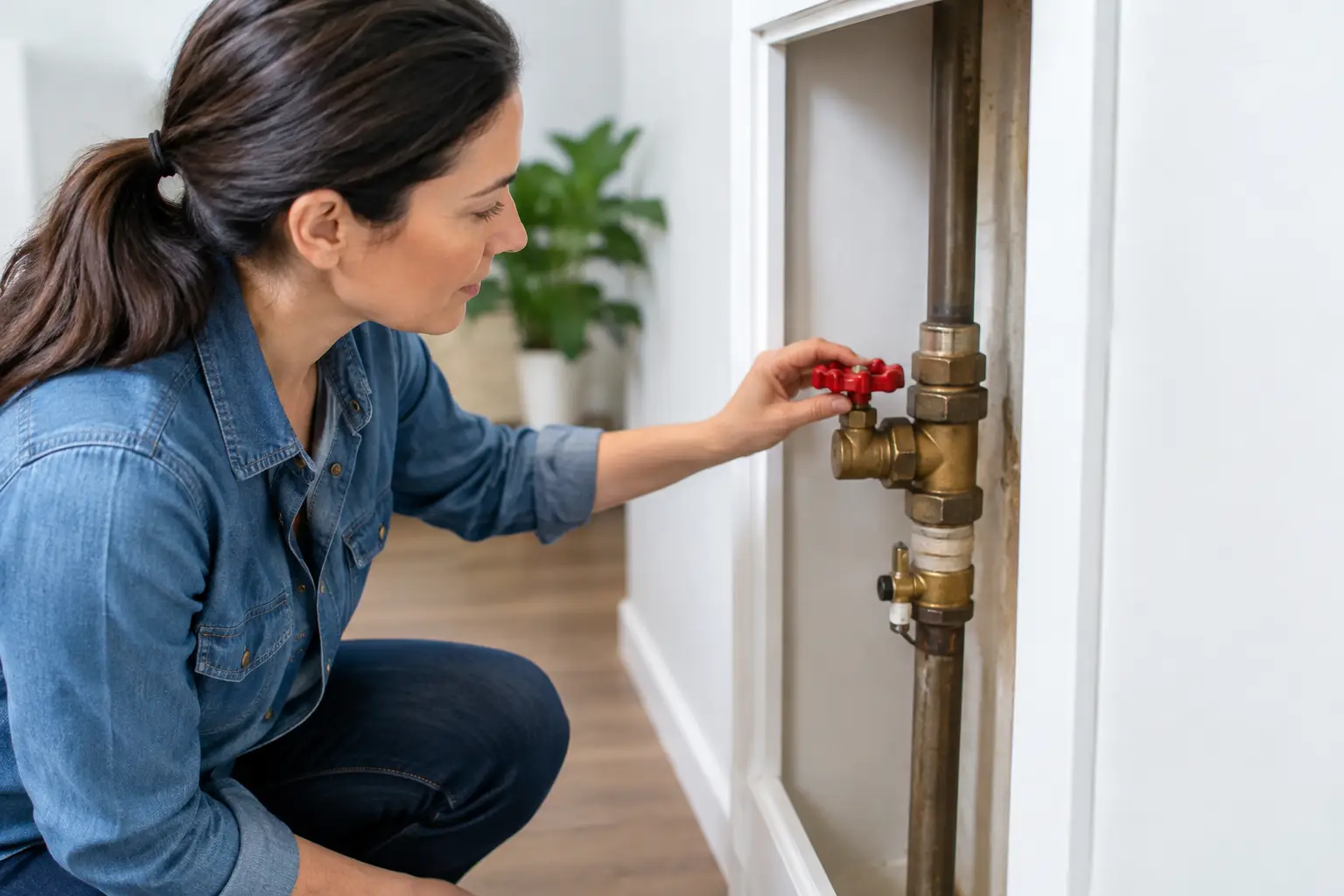
A burst flexi hose under the vanity can release a surprising amount of water in minutes. Knowing how to locate main shutoff valve before that happens gives you a chance to stop the flow, protect flooring and cabinetry, and wait safely for a licensed plumber. It is one of the most useful things every homeowner, landlord and property manager can check before an emergency.
Your main water shutoff valve controls the water supply entering the property. Turn it off and taps, toilets, washing machines and most other cold-water fixtures should stop receiving water. It is not the same as the gas shutoff, and it may not stop water already stored in a hot-water system.
What the main shutoff valve looks like
In many Sydney homes, the main shutoff is a small valve fitted to the incoming water pipe close to the water meter. It may have a round wheel handle, a short lever, or a brass body with a slot for a stopcock key. Older properties often have a wheel-style stop tap, while newer installations may use a quarter-turn ball valve with a lever.
A lever valve is generally open when the handle runs in the same direction as the pipe. It is normally closed when the handle sits across the pipe. Do not rely on this alone if the pipework is unclear. Check the valve position, then test a cold tap inside once it is safe to do so.
The water meter itself records water use. The shutoff valve may be immediately beside it, but layouts vary. You may find one valve on the street side of the meter and another on the house side. The house-side valve is usually the one you need for isolating water inside the property.
How to locate the main shutoff valve outside
Start at the front boundary of your property. In detached houses across Western Sydney, the meter is often in a small box or pit near the front fence, driveway, nature strip or footpath. Look for a plastic, metal or concrete cover marked “Water”, “Water Meter” or a water authority symbol.
Lift the cover carefully. Spiders, ants, dirt and standing water are common, so wear gloves and use a torch rather than reaching in without looking. Inside, locate the meter and trace the pipe leading towards the house. The isolation valve is commonly fitted on this side.
If the cover is buried under soil, mulch, pavers or overgrown plants, do not start digging around blindly. You could damage the meter, pipework or other underground services. A licensed plumber can identify the supply point and make sure the valve remains accessible for future emergencies.
Some properties have an additional shutoff valve near the building. Check along the external wall, under a front tap, near the garage, or where the water pipe enters the home. This valve can be easier to reach than the meter box and is often the practical choice during a leak.
Check common indoor locations too
Not every main shutoff is outdoors. In townhouses, villas and older homes, it may be in a laundry, under the kitchen sink, inside a cupboard, beneath the house, in a garage or beside the hot-water unit. Look for a larger pipe entering from outside and follow it to the first valve.
Do not confuse the main valve with an appliance isolation valve. Small valves under a basin, behind a toilet, beside a dishwasher or at the washing machine usually isolate only that fixture. They are useful when a single tap or flexi hose fails, but they will not stop a burst pipe elsewhere in the home.
For a leaking toilet or mixer tap, shutting off the local isolation valve can limit disruption while you arrange repairs. If water is coming through a wall, ceiling or floor, or you cannot identify the source, use the main shutoff instead. This is faster and safer than waiting for visible water damage to reveal the problem.
Apartments, strata buildings and commercial premises
Apartments and strata properties can be more complicated. Your individual water isolation valve may be in a service cupboard, laundry, hallway cabinet, basement riser cupboard or meter bank. There may also be separate common-property valves that should only be operated by building management or an authorised plumber.
Avoid turning off unfamiliar valves in a shared plant room. You could shut down water to neighbouring lots or a whole section of the building. Tenants should contact the landlord, property manager or strata manager, but a serious active leak still needs immediate action. If you can safely isolate the water to your own lot, do so and report it straight away.
Commercial sites may have multiple supplies for amenities, kitchens, fire services, irrigation or specialised equipment. Never turn off a valve that may affect fire protection without confirming its purpose. A licensed plumbing technician can identify the correct isolation point and minimise downtime.
Turn it off only when you need to
For a wheel-style stop tap, turn the handle clockwise slowly until it stops. For a lever-style ball valve, rotate the lever a quarter turn so it sits across the pipe. Do not force a valve that is seized, corroded or difficult to move. Excess pressure can snap an old handle, damage the valve spindle or create a larger leak at the meter.
Once it is closed, open a cold tap at the lowest convenient point in the home, such as a laundry tap, to confirm the supply has stopped and relieve remaining pressure. Some water will continue to run briefly from the pipes. Toilets may still flush once or twice because their cisterns are already full.
If water continues to flow strongly after the main valve has been closed, the valve may be faulty, you may have shut off the wrong line, or the water may be coming from a stored hot-water unit. Switch off electrical power to an electric hot-water system only if it is safe to access the switchboard and no water is near electrical equipment. For gas hot water, do not attempt gas repairs yourself.
Do not wait for a leak to test it
The best time to find and test your shutoff valve is when nothing is leaking. Let everyone in the household know where it is, especially anyone who may be home during the day. For rental properties, include the location in the property information pack and make sure the valve is not hidden behind stored items or locked in an inaccessible cupboard.
Test the valve gently every six to 12 months. If it feels stiff, leaks around the spindle, will not fully shut off, or has been buried under debris, arrange a repair before an emergency makes it urgent. A valve that has not moved in years often fails at the exact moment you need it.
It is also worth labelling the valve with a weatherproof tag where practical. A simple label can save valuable minutes for family members, tenants, cleaners, maintenance staff or a plumber attending after hours. Keep a torch and gloves somewhere easy to find, particularly if the meter box is outside.
When to call a plumber straight away
Turn the main water off and arrange urgent plumbing help if you have a burst pipe, water pouring from a ceiling, a failed flexi hose, an overflowing toilet that will not stop, or a major leak under the house. Move valuables away from the area if safe, keep clear of wet electrical points and do not use appliances affected by water.
If the valve is seized, the meter pit is damaged, or you cannot find the shutoff while water is spreading, do not lose time searching. Tru Blu Plumbing Group provides fast-response emergency plumbing across Western Sydney, South-West Sydney, the Hills District and North-West Sydney. A licensed plumber can isolate the supply, locate the fault and carry out the right repair with clear communication about the work required.
Knowing where the valve is will not prevent every plumbing failure, but it can turn a damaging water emergency into a controlled repair. Find it now, make sure it works, and keep the path to it clear.